
Overview
RV Windows across Utah & Las Vegas
RV glass is specialty work, which is exactly why most auto glass shops pass on it. A motorhome uses laminated windshields (often as two large separate halves on a Class A), tempered side windows set in their own frames, sealed dual-pane insulated units, entry-door glass and marked emergency-exit windows — in sizes and radii that simply don't exist in a passenger-car catalog. Icon Auto Glass sources the correct panels for Class A, B and C motorhomes, travel trailers, fifth wheels and toy haulers, then does the work where the rig already sits.
We look at repair first, when repair is the honest answer. A Class A windshield is one of the most expensive pieces of glass on the road, so it's worth finding out whether yours actually needs replacing. A fresh rock chip or a short crack outside the driver's critical viewing area can often be stabilized with resin, stopping it from running further and saving the panel. What we won't do is talk you into a repair that's going to fail — on a windshield that flexes as much as a motorhome's does, a long crack or one that has reached the edge is a replacement, and we'll say so.
Fogged dual-pane windows are their own problem, and that haze is not dirt. Many RV side windows are insulated units: two panes of glass with a sealed air gap between them. When the perimeter seal fails, humid air works its way in, and every time the rig heats up and cools back down that moisture condenses on the inside surfaces where no cloth will ever reach. You'll see haze, water streaking, or a chalky mineral film between the panes. Cleaning does nothing and it doesn't reverse on its own — the fix is replacing the failed insulated glass unit, or the full window assembly when the frame or seal channel has gone too.
Utah and Nevada are unusually hard on RV glass, and elevation is the part owners don't expect. A rig driven over Parleys Summit, up through Price Canyon, or across the high country toward Moab and St. George goes through real pressure and temperature swings inside a single day, and dual-pane seals age faster under that cycling than they do on a trailer that never leaves sea level. Add a Nevada summer on a coach parked in the open, UV on seals that are already decades old, and I-15 gravel hitting a windshield that stands nearly upright and almost flat, and the failure pattern around here starts to make sense.
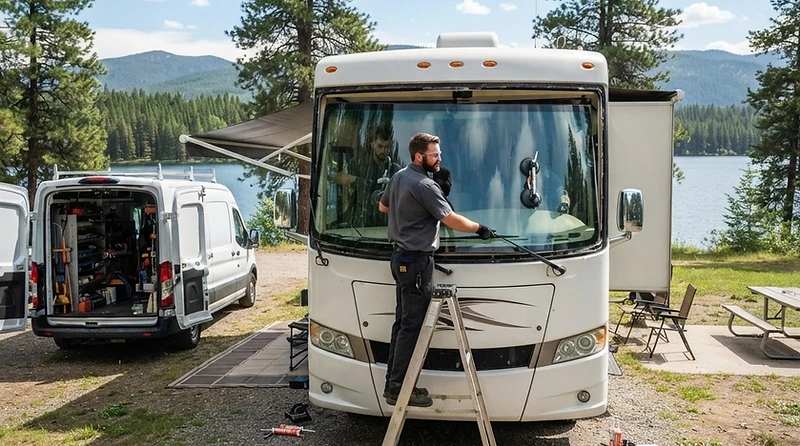
You can't drive a 38-foot coach into a glass bay, so we don't ask you to. We service RVs at campgrounds, storage lots, driveways, repair facilities and dealer yards across the Wasatch Front and the Las Vegas valley, and we restore the seals and weatherproofing properly on the way out — because a window leaking into a wall cavity on an RV is a far more expensive problem six months from now than it is today.
- Chip & crack repair on motorhome windshields
- Fogged dual-pane window units replaced
- Class A, B & C motorhomes, trailers & fifth wheels
- Windshields, side, entry-door & emergency-exit glass
- On-site at campgrounds, storage lots & driveways
- Seals & weatherproofing restored
FAQ
RV Windows questions
The fog sits between two panes of a sealed insulated unit, so it can't be cleaned or dried out from either side — the seal has already failed. The practical fix is replacing the insulated glass unit itself, and if the frame or seal channel has deteriorated as well, the full window assembly.