Tips & Maintenance
Classic Car Glass Before Winter Storage: What to Check in October
Check it now, not in March
Most classic owners inspect the car on the way out of storage. That's backwards for glass. Anything you find in April has had five months to get worse, and anything you need to order has a lead time measured in weeks. October is the month to look.
The rubber fails long before the glass does
Original gaskets are the weak point on nearly every car built before urethane bonding became standard. Vintage glass sits in a rubber channel rather than being glued to the body, and that rubber has a service life. Utah is hard on it from both directions: dry air pulls the plasticizers out, and sun at altitude does the rest. The gasket shrinks, hardens, and stops sealing long before it looks obviously bad.
Winter is when that bites. Water gets into the gap between glass and pinch weld, sits there, freezes, and expands. Repeat that forty times between November and March and you get two outcomes — a lifted, leaking seal, and rust starting in the one place on the car you can't see until the glass comes out. On a car where the window frame is part of the body, that repair gets expensive fast.
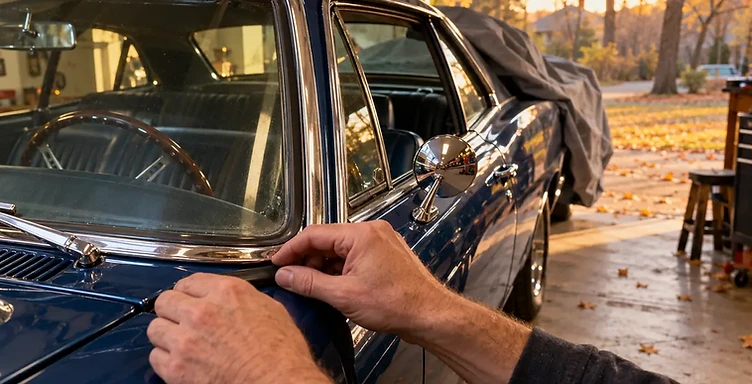
Press along the gasket with your thumb. If it's stiff, chalky, cracked at the corners, or pulled away anywhere, deal with it before the car goes under a cover.
Classic glass isn't a next-day part
This is the other reason to look in October. Modern glass comes off a shelf. Vintage glass often doesn't. Depending on the car you're looking at new old stock, a reproduction pane, or in some cases flat glass cut and polished to a pattern. Curved rear windows and wraparound windshields from the fifties and sixties are the hardest to source and the slowest to arrive.
If you find a problem now, the part can be on its way while the car sits anyway. If you find it in spring, you've lost the first good month of the driving season waiting on a piece of glass.
A crack gets worse in storage, not better
People assume a parked car is a frozen car. It isn't. An unheated garage along the Wasatch Front can swing thirty or forty degrees between a sunny afternoon and a January night, and glass expands and contracts with every one of those cycles. A crack is a stress concentrator — each swing works the tip of it a little further across the screen. A six-inch crack in November is regularly a full-width crack by March, and at that point you're replacing rather than repairing.
If your classic is going away with damaged glass, the cheapest version of that job is the one you do before it's put away.
Before the cover goes on
Clean the glass inside and out so nothing acidic sits on it for five months. Clear the window channels and drain holes in the doors. Leave the windows cracked a quarter inch if the car is in a dry space, which cuts the moisture that builds up under a cover. And treat the gaskets with a proper rubber conditioner rather than a silicone spray, which can accelerate the drying it's supposed to prevent.
We handle classic and vintage glass across Utah, including gasket-set installation on cars that were never designed for urethane. If you're not sure whether what you're looking at is a seal problem or a glass problem, send us a photo before you order anything.